
Betting explained
Sports Spread Betting Explained and What It Costs
Sports spread betting pays on how right you are, not just whether you are right. You buy or sell a number, such as total goals, at a price per point, and every point the result moves past your number adds to the win or the loss.
 By
By

What sports spread betting is
A sports spread bet is a bet on a number. The firm quotes a range, the spread, for something that can be counted: goals in a match, runs in an innings, corners, bookings points, a winning distance. You buy if you think the final number will come in above the range and sell if you think it will come in below.
Instead of a fixed price, you choose a stake per point. The bet is settled on the difference between the final number and the side of the spread you traded, multiplied by that stake. There is no fixed return and, unless you cap it, no fixed loss.
- You trade a number, not an outcome
- You pick a stake per unit, such as 10 pounds a goal
- The win or loss grows with every unit the result moves
Buying and selling a spread
Every spread bet has the same four parts.
-
The quote
The firm shows two numbers, for example total goals 2.6 to 2.8. The lower one is the sell price, the higher one the buy price.
-
Buy or sell
Buy at 2.8 if you think the match will produce more goals than that. Sell at 2.6 if you think it will produce fewer.
-
Choose the stake
Pick a stake per unit. At 10 pounds a goal, every goal the result lands away from your price is worth 10 pounds, for or against you.
-
Settle on the result
When the market closes the result is compared with your price. Three goals on a buy at 2.8 is 0.2 of a goal up, a 2 pound win.
The spread is the firm's price
The gap between the sell and the buy price is where the firm earns its margin. Its own view of the match sits in the middle, and whichever side you trade, you trade from the edge of the range, a tenth of a goal worse than the middle on this quote.
What a spread bet really risks
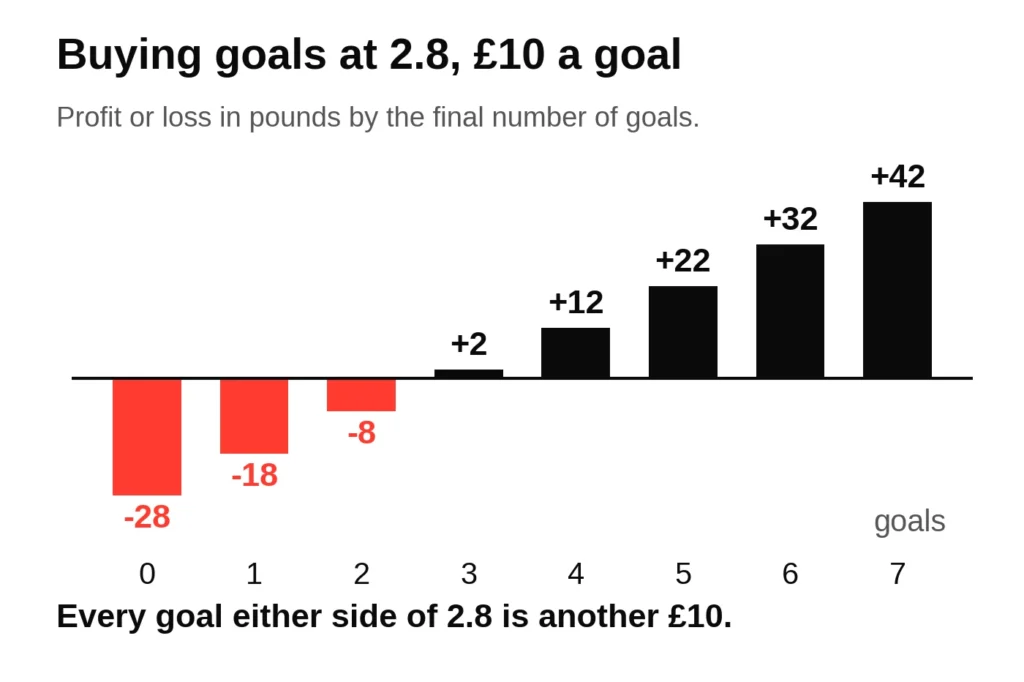
Buy total goals at 2.8 for 10 pounds a goal and the whole range of outcomes opens up. The bet does not lose a stake, it loses 10 pounds for every goal short of 2.8 and wins 10 pounds for every goal beyond it.
- A goalless draw loses 28 pounds, close to three times the stake per goal
- One goal loses 18 and two goals lose 8
- Three goals wins 2, four wins 12 and six wins 32
The maths is symmetrical, and so is the risk. Selling the same market at 2.6 loses 10 pounds for every goal above 2.6 with no upper limit, so a 6-4 thriller costs 74 pounds on a 10 pound stake. That open end is what separates a spread bet from every other bet on this site.
Spread markets by sport
Anything that can be counted can be spread, and the British firms go well beyond goals.
- Football: total goals, supremacy (the winning margin in goals), corners, bookings points and the total of goalscorers’ shirt numbers
- Cricket: runs in an innings, a batter’s score, boundaries and wickets
- Horse racing: winning distances, and index markets that pay points by finishing position
- Golf, rugby, tennis and darts: totals, winning margins and match performance indices
Most spreads are also traded in running, repriced through the match in the same way as live betting prices, and a spread can be closed early at the current quote.
Limiting what a spread bet can lose
Because a spread has no natural floor, the firms offer ways to put one in. A stop loss closes the bet automatically at a set level; a capped or limited-risk bet fixes the most it can lose from the start. Both usually cost something, either a slightly wider spread or a cap on the win as well.
Without a limit, the most a bet can lose depends on the market. A buy on total goals can lose no more than the buy price times the stake. A sell can lose without a ceiling, which is why firms also set a deposit or credit limit on the account.
What the spread costs you
The cost of a spread bet is the distance between the middle of the quote and the price you trade. On a 2.6 to 2.8 goals quote with a fair mid of 2.7, that is a tenth of a goal, or 1 pound per bet at 10 pounds a goal.
The fair comparison is not the stake but the money that actually changes hands. Worked through for a match expected to produce 2.7 goals, the average win or loss on that bet is 13.22 pounds, so the spread takes 7.6 per cent of the action. A US point spread priced at -110 on both sides takes 4.76 per cent. The same overround arithmetic applies to both; the spread simply hides it inside the range.
- Total goals spread 2.6 to 2.8: 7.6 per cent of the money that changes hands
- Point spread at -110 both sides: 4.76 per cent
- A tighter quote, 2.65 to 2.75, roughly halves the spread cost
What a +7 or -7 point spread means
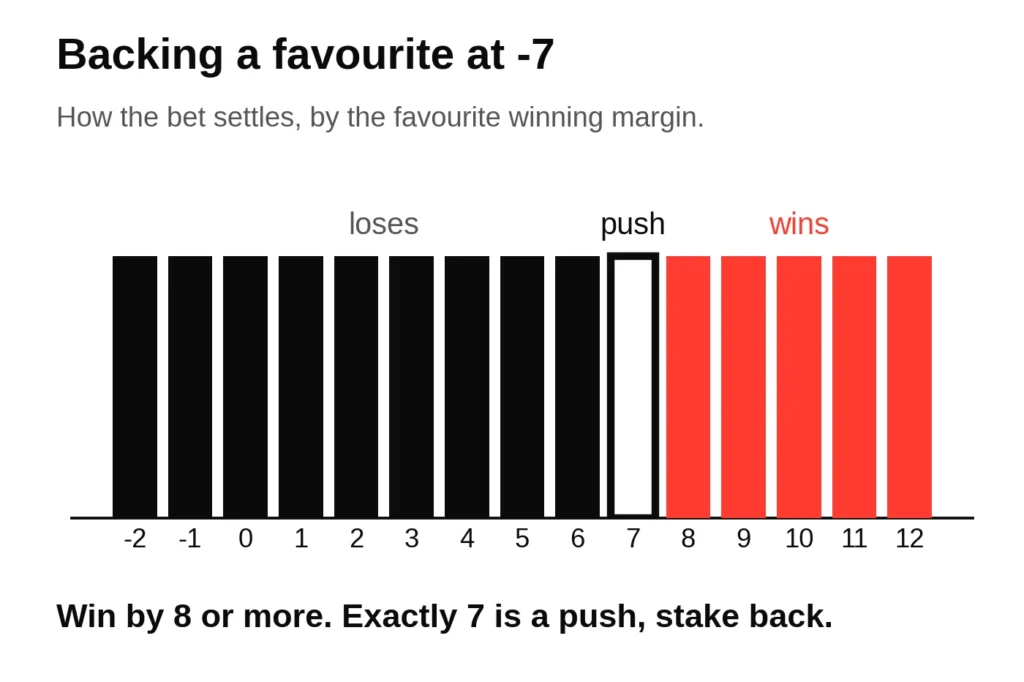
In American sports a spread means something different: a handicap on a fixed-odds bet. A team at -7 must win by more than seven points for the bet to win; a team at +7 wins the bet if it wins the game or loses by fewer than seven.
Winning by exactly seven is a push and the stake comes back, which is why so many lines are set on half points, -6.5 or +7.5, so that every result settles one way or the other. The standard price of -110 on both sides reads as a 110 stake to win 100, and American odds explained shows how that converts to decimal and fractional prices.
Point spreads, handicaps and the British equivalent
A point spread is a fixed-odds bet with a head start. The stake is the most it can lose, and the payout is set when the bet is struck. British and European books sell the same idea as handicap and Asian handicap betting, and the football betting markets carry both on almost every match.
- Point spread and handicap: fixed stake, fixed price, one line to beat
- Sports spread: stake per unit, open-ended win and loss, settled on the exact result
Spread betting or fixed odds
- A return that grows with how right you are
- The option to sell, which is the same as laying a result
- Markets that fixed odds rarely offers, such as shirt numbers and bookings points
- A loss that can never be more than the stake
- A price you know before the bet is struck
- A far wider choice of books and markets
Where sports spread betting sits in Britain
Sports spread betting in Britain is regulated as a financial product by the Financial Conduct Authority, not as gambling by the Gambling Commission. The market is small, a couple of firms carry almost all of it, and opening an account means the appropriateness questions any leveraged product requires, plus a deposit or credit limit before the first bet.
For a punter who wants a view on a margin or a total without an open-ended loss, the handicap, Asian handicap and point spread markets do the same job at a fixed stake, and books licensed outside Great Britain price them on far more matches than the British spread market covers. Handicap and total markets like these are part of the markets test for betting sites in our ranking.
Spread betting questions answered
Betting on a number, such as total goals or runs, by buying above a quoted range or selling below it at a stake per unit. The win or loss is the difference between the result and your price, times the stake.
The firm quotes a range for something countable, such as 2.6 to 2.8 goals. Buy at 2.8 if you expect more goals, sell at 2.6 if you expect fewer, and each goal either side of your price is worth your stake.
Yes. The stake is per unit, so a bet can lose several times that amount. A stop loss or a capped bet limits it.
In US point spread betting, the team at +7 wins the bet if it wins the game or loses by fewer than seven. Losing by exactly seven is a push.
The favourite must win by more than seven points for the bet to win. Winning by exactly seven returns the stake.
The side gets a head start of one and a half points or goals. It wins the bet with a win, a draw or a one-point defeat, and the half point means there is no push.
No. A handicap or point spread is a fixed-odds bet with a head start and a stake that is the most you can lose. A sports spread bet has a stake per unit and no fixed return.
The distance between the middle of the quote and the price you trade. On a 2.6 to 2.8 goals quote that is a tenth of a goal, about 7.6 per cent of the money that typically changes hands.