 By
By
Top Choice
1

Gamble Gorilla
- Exclusive Free Bet Offer
- In-Play Live Betting
- Broad Sports Coverage
Bonus
WELCOME SPORTS FREEBET
UP TO £100
FREEBET
UP TO £100
FREEBET

Bookmaker ranking
The best betting sites for a UK punter are the ones that price keenly, let you stake what you want and pay out without a fight, and that is what this ranking measures. Below the list you will find how we score a book, what each sport really costs to bet on, where a site’s prices come from, the house rules that decide what you are paid, and where offshore books fit in.














Every book in the table above is scored on the same tests, whichever sport or feature brought you here. The weighting changes from guide to guide, because a racing punter needs different things from a crypto punter, but the tests themselves never do. They are listed below in the order they cost you money.

Price and limits come first because they apply to every bet you place.
The margin on the markets you actually bet, set against the keenest price available. A book two points dearer on every bet costs more over a season than any welcome offer returns, and our guide to the margin built into a price shows the arithmetic.
How much the book lets you stake, and how quickly it cuts that down once you win. A good price you cannot get on at is worth nothing, which is why limited and closed accounts are a scoring test here, not a footnote.
How long a withdrawal takes from the moment you ask for it to the money reaching you, and how many document requests stand in between.
Maximum winnings, the obvious error rule, and how voids and abandoned events are settled. They decide what a winning bet pays, so they have their own section further down.
Depth beyond the headline fixtures: lower leagues, player markets, each way terms, and in-play coverage on the sports you follow.
The score is about what a book does with your money, not how it looks.
A betting site is one of three kinds of business, and the kind decides who is on the other side of your bet. Almost every site in the list above is a bookmaker, but the other two are worth knowing, because each charges you in a different way.
| Bookmaker | Sets its own prices and takes the other side of your bet. It earns the margin built into every price, and it can limit what you stake |
|---|---|
| Betting exchange | Matches your bet with another punter who takes the opposite view. It takes no side itself, so it earns commission on your net winnings instead of a margin |
| Spread betting firm | Quotes a range rather than a price, and your win or loss grows with how far the result lands from it. Our page on how sports spread betting works sets out the risk |
| What you pay | At a bookmaker, the margin, on every bet. At an exchange, commission, only when you win. At a spread firm, the gap between the buy and the sell quote |
A bookmaker’s prices on any market add up to more than 100% once you turn them into chances. The excess is the margin, and across thousands of bets it is what the book keeps, whoever wins any one of them. The book is not really betting against you. It is charging you to bet.
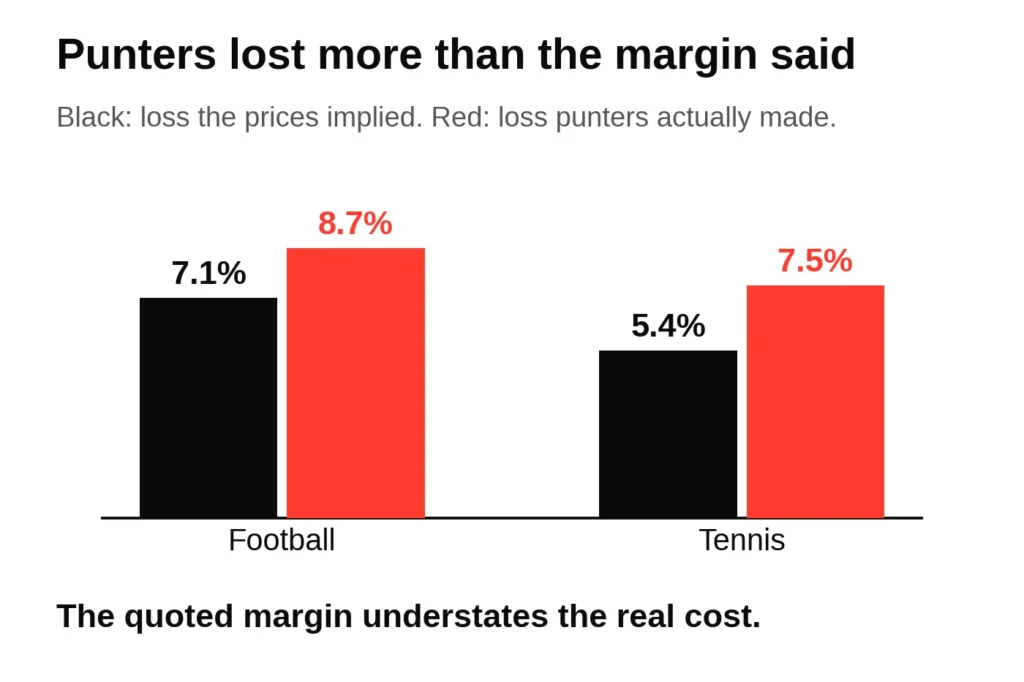
And the quoted margin understates the charge. Hegarty and Whelan at University College Dublin studied 151,683 football matches and 130,243 tennis matches (Applied Economics, 2025) and found punters lost more than the prices implied: 8.7% against a quoted 7.1% on football, 7.5% against 5.4% on tennis. The gap comes from where the money goes. On football the loss ran from about 3% at the shortest prices to 19% at the longest, and punters love a long price.
We have measured margins across the guides on this site, and one pattern holds on every sport. The more outcomes a market has, the more of each pound the book keeps.
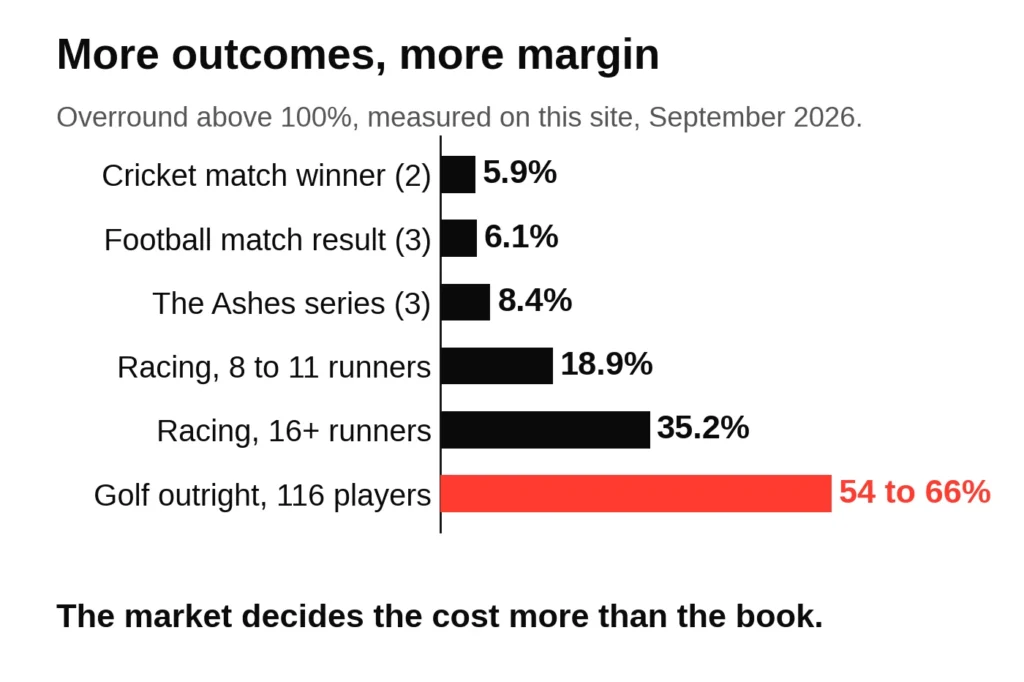
No betting site can make a 116-player market cheap. The keenest single book on that golf outright still charged about nine times what the market charges on a football result. So the first saving is choosing the market, and the second is choosing the book, and on long fields the second saving is large, because books disagree most where there are most outcomes to price. On the golf event the best price across all books added up to 139.9%, against 153.9% at the keenest single book; on a cricket match winner the same gap was about four points.
A betting site gets its prices in one of two ways. Some books employ their own traders, who set the opening prices, move them as money comes in and decide how much to take on each selection. Many others buy the whole operation in: a trading supplier sets the prices, runs the risk management and can take over the trading entirely, a package sold to bookmakers as a managed trading service.
So the site you see and the people pricing your bet are often different companies. Several brands can sit on one supplier’s feed, show you the same number to the decimal place and apply the same risk rules behind it.
Two browser tabs and a couple of minutes are enough.
A match result, a correct score and a player market on the same fixture. Match results tend to converge everywhere; the deeper markets are where independent books differ.
Convert both sets of prices to decimal. If all three markets match exactly, the two sites are almost certainly reading one feed. Converting is covered in our guide to reading betting odds.
Refresh both tabs while a price changes. A shared feed moves on both at the same moment.
A second account is only a second price if the book prices for itself. Two sites on one feed are one price with two logins.
Brand names hide two more layers. One licence holder can trade under many domain names, and several licence holders can belong to one group that shares its trading, its risk team and its terms.
The licence holder is the easiest to check, because the terms have to name it, and our guide to recently launched books shows how to read a register entry and its list of domains.
Every betting site publishes general rules alongside its offer terms, and they matter more than the offer, because they apply to every bet you will ever place there. Four of them decide what a winning bet actually pays.

| Maximum winnings | A cap on what one bet, or one customer in one day, can win. It is usually set per sport and per market, and far lower on minor leagues and specials than on the Premier League. A long-priced treble can win more than the cap and be paid only the cap |
|---|---|
| Obvious error | Also called palpable error. If a price was plainly wrong when you took it, the book can void the bet or resettle it at the correct price, even after the result is known |
| Voids and abandoned events | What happens when a match is abandoned, a player retires or a runner is withdrawn. A void leg in a multiple usually settles at 1.00 and the bet runs on, as our guide to accumulators and multiple bets works through |
| One account per person | Most books allow one account per person, household, device or payment card. A second account at the same book can see both closed and the winnings withheld |
Not every rule is a restriction. Some books add concessions to their racing rules, and these belong in the comparison too.
Yes, for the punter. The Gambling Act 2005 licenses whoever provides the bet, and every offence it creates is written for the provider: offering gambling in Great Britain without a Gambling Commission licence is the operator’s affair. Nothing in the Act makes it an offence for you to place a bet with a book licensed elsewhere, in Curacao, Anjouan or Malta.
What changes is whose rules apply. A book licensed outside Great Britain works to its own regulator’s rules, so the UK checks, caps and offer limits do not bind it. That freedom is the reason offshore books have a place in the British market at all, and it is also why they reach your phone as a mobile site rather than an app store download, as our guide to betting apps and mobile sites explains.

A book that fails the first two is not worth a deposit. A book that passes all five has shown you how it behaves before you have risked anything.
The same six questions, answered well and answered badly.
| Criterion | What we look for Strong betting site | Weak betting site |
|---|---|---|
| Prices | Close to the keenest price on the markets you bet | Two or three points dearer on every market, hidden behind boosts |
| Limits | Takes a sensible stake and keeps taking it after you win | Cuts stakes to pennies after a few winning weeks |
| Payouts | Pays within a day once your documents are cleared | Pending for days, with a new document request at each withdrawal |
| House rules | Maximum winnings stated per market, in plain English | Caps buried in the general rules, low on minor markets |
| Offers | Modest, with terms you can meet with normal bets | A big headline figure, heavy wagering and tight minimum odds |
| Markets | Depth below the top flight, and in-play on the sports you follow | The Premier League and the big races, and little else |
These are the qualities we score, not a description of any named book.
Our sport guides cover football, racing, golf, cricket, darts and boxing, the six that carry most British betting. Most betting sites price far more than that, and the rule from the margin figures above holds on all of it.

| Tennis | Match betting, set betting and game handicaps, on almost every day of the year. The quoted margin runs a little under football’s, but punters lost 7.5% against a quoted 5.4% in the UCD study. Point-by-point prices are covered in our guide to live betting |
|---|---|
| Snooker | Match winner, frame handicaps and correct score, plus outrights on ranking events. Match bets are two-way and cheap; the tournament winner is a field |
| Rugby union and league | Handicaps and total points are the main markets, because many matches are one-sided enough that the match winner price is very short |
| Formula 1 | Race winner, podium finish and head-to-heads between drivers. The head-to-head is two-way and the cheapest F1 bet; the race winner is a field of more than twenty cars |
| American sports | NFL and NBA are priced as point spreads, totals and moneylines (a straight bet on the winner), quoted in American odds at some sites and in decimal at others |
| Politics and specials | Elections, party leaders and television awards. Markets are thin and caps are low, so read the maximum winnings line before a big stake |
Every guide on this site ranks the same books against a different need. Start from the sport you follow, or from the one thing that matters most to you.
| Football | The keenest and most shopped market of all. Our guide to football betting sites measures the margin on every main market across six books |
|---|---|
| Horse racing | Early prices, starting price and place terms, with a full week of measured SP books behind the best horse racing betting sites |
| Golf | Long fields, wide margins and each way terms that differ from book to book, all measured in our golf betting guide |
| Cricket | Test, one-day and T20 cricket each price the draw and the weather differently, as cricket betting sites sets out |
| Darts | Legs and sets, 180s and checkouts, and the World Championship over Christmas, in our darts betting guide |
| Boxing | A three-way market with the draw, plus method of victory and round betting, for fight nights at boxing betting sites |
Each of these ranks the same list on a single test.
Offers valued in cash rather than by the headline, at the odds you would really use them. Start with the best betting sign up offers.
Which coins and payment rails work where, and what converting costs next to the margin, in crypto betting sites.
Where the time goes in a withdrawal and how to shorten it, in fast withdrawal betting sites.
Singles to a Goliath, each way and void legs included, with our bet calculator.
There is no single best one, because the right book depends on what you bet on. The books in our ranking at the top of this page are scored on price, limits, payout, house rules and markets, and each of our guides reweights those tests for one sport or one need.
Yes. Betting is legal in Great Britain, and the Gambling Act 2005 places its licensing duties on the provider of the bet. Using a book licensed in another jurisdiction is not an offence for the punter.
An offshore book is as safe as its licence, its terms and its payment record. Check that the licence number in the footer appears on the regulator’s register, that the terms name a company, and that a small first withdrawal arrives as promised.
A bookmaker builds a margin into every price, so the prices in a market add up to more than 100%. Across thousands of bets the excess is what it keeps, whoever wins each one. An exchange charges commission on winnings instead.
Either from their own traders or from a trading supplier that sets the prices and manages the risk for them. When several brands buy from one supplier, they often show identical prices.
Many brands share a licence holder, and many licence holders belong to one group. The licence holder is named in each site’s terms and on the regulator’s register, which lists the domains it trades under.
A betting site, or bookmaker, sets the price and takes the other side of your bet. An exchange matches you with another punter and charges commission on your net winnings.
No. Betting winnings are not taxed for individuals in the UK, whichever book pays them.
Yes, and most regular punters do, because it is the only way to take the best price on each bet. What books forbid is a second account at the same book.
The most one bet, or one customer in one day, can win. It is set in the general rules, often per sport and per market, and a winning bet above it is paid only the cap.