 FF Info
New Betting Sites UK 2026 — Evaluating a Newly Licensed Operator
New betting sites uk get more attention than they deserve. A newly launched UKGC operator has no long-run track record and no complaint history to interrogate.
This guide sets out the checks a cautious UK consumer runs before trusting a new site with a first deposit.
18+ T&Cs apply. Please gamble responsibly.
Why "new" is not automatically a virtue
"New" is a marketing frame. A new operator launches with clean UI, promotional generosity and an eager press release, but it has no payout history for you to inspect and no complaint trend for anyone to graph. The ranking on our best betting sites home page therefore places a natural weight on operators with track records; new operators must earn their way in.
That is not to say new is bad. Some launches are technically strong: modern platforms, sensible terms, well-designed responsible-gambling tooling. Others are re-skins of dormant licences under new branding, and re-skins carry the risk profile of the original operator behind them. The first job of a review is to work out which of the two you are looking at.
Consumers who chase every new site with a first deposit build a portfolio of tiny KYC files across a portfolio of operators of unknown quality. That is a bad shape to have your data in. Move slowly, test one at a time, and let time do some of the filtering for you.
New launches also attract higher marketing spend per acquired customer than mature operators. That spend has to be recovered somewhere, and the two common recovery mechanisms are reduced payouts on niche markets and slower withdrawal processing during the first few weeks. Neither is illegal; both are worth testing for.
Consumers who want to try new sites are best served by treating the first three months as a probation period during which they test the operator against the same discipline they would use on any other service. Loyalty comes later, if it comes at all.
A useful mental model for new operators is the notion of a runway. Every new operator has a runway measured in months of operating cost during which it must acquire customers, convert them and stabilise its unit economics. Runway pressure explains many of the acquisition tactics you will see.
Readers who watch a new operator over its first year can often predict its long-term shape. The operators that stabilise into steady, quiet service tend to have looked steady and quiet from the start; the operators that stayed loud, promotional and marginally compliant tend to keep failing consumers.
Confirming the UKGC licence
Start on the UK Gambling Commission public register. Search by the operator's trading name or by its company number if provided. Confirm the licence is live, note any conditions, and note the disclosed segregation level for player funds. If the operator's public branding does not match a live licence, stop.
The register is authoritative. Third-party lists and comparison tables can be out of date; only the register itself is current. A new operator that shows a licence on its website but is absent from the register is either mid-application, mid-migration or mid-something-you-do-not-want-to-be-part-of.
The register also lists domain names associated with each licence. That is a useful check when an operator markets under a brand that differs from its trading name; if the marketed domain is missing from the licence page, ask the operator to explain.
Licence conditions are worth reading in full for a new operator. Some conditions apply to specific markets or to responsible-gambling requirements the operator must meet within a stated timeframe. Reviewers who ignore these conditions miss the most interesting parts of the register.
Ownership, platform and re-skins
Ownership tells you who profits. Platform tells you who runs the systems. Re-skin tells you whether the operator is really new or just newly branded. All three are worth ten minutes of research before a first deposit.
Ownership: look for a parent company in the terms and match it to a Companies House filing. Platform: look for the software provider footnote. Re-skin: search the licence account number on other operator brands — sometimes several brands sit on one licence, in which case complaints and history follow the account, not the brand.
Ownership research also uncovers cross-brand history. If the parent company has had public failures at previous brands, that history follows the ownership even when the brand is new. Consumers are entitled to take historic behaviour into account.
Platform research uncovers cross-brand technical history. Two brands on the same platform will share bugs, outage windows and support scripts. If one brand is troubled, the other is probably worth extra scrutiny.
Ownership research is public information available at Companies House and in the operator's own terms. Neither costs anything. The ten minutes invested is one of the highest-return activities a UK consumer can spend on new-operator research.
Red flags to run away from
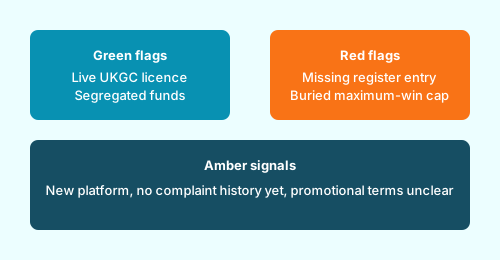
- No live UKGC licence on the public register.
- Missing responsible-gambling tooling on the account settings page.
- Terms and conditions locked behind a login wall.
- Maximum-win cap buried after clause 14 of a promotion.
- Payment-method list that includes methods with no chargeback protection.
- Support that will not confirm actions in writing.
- Marketing language that promotes evasion of any regulatory tool.
Any single red flag disqualifies an operator for the money-page ranking. Two together is a warning to walk, not run, and to warn other consumers where you have standing to do so.
Marketing language that promotes evasion of a regulator or of a self-exclusion register is a serious red flag. UKGC-licensed operators would not market that way; unlicensed ones sometimes do. Either way, an editorial site that lists such an operator without disclaimers is not doing its job.
Red flags also appear in the operator's public statements. Marketing copy that boasts about how easy it is to open an account, without matching commitment to responsible-gambling tooling, is telling you exactly how the operator prioritises its own consumer-protection responsibilities.
Amber signals that need explanation
Amber signals are not disqualifying but demand an operator response. They include a new platform with no independent uptime data, a lack of complaint history caused simply by low volume, unclear promotional terms that could be tightened up, and a small support team that has not yet been stress-tested at match times.
Amber signals often clear as the operator matures. What you want to see is a public plan for clearing them — a scheduled uptime report, a hire announcement for support scale, a promotions rewrite. Silence on amber signals turns them slowly red.
| Signal | Colour | Test |
|---|---|---|
| UKGC licence live | Green | Register search |
| Segregated funds high | Green | Terms disclosure |
| Complaint history absent | Amber | Time only fixes this |
| Small support team | Amber | Stress test at match times |
| Buried max-win cap | Red | Terms rewrite required |
| Missing RG tools | Red | Disqualifying |
Amber signals reward operators that own them publicly. An operator that publishes a two-page write-up explaining what it has done to address a complaint spike, with dates and outcomes, has demonstrated exactly the kind of institutional response that mature operators eventually settle into.
Green flags worth crediting
Green flags for new operators are often understated because they are systemic rather than promotional. A published uptime figure. Segregated funds at the "high" level. A support team that answers cool-off requests without pushback. A clear, short set of promotional terms. These are the things that predict quiet quality for years.
Green flags do not need to justify the operator's marketing; they justify the operator's operations. The two are not the same. A quiet green-flag operator is often a better home for your account than a loud amber-flag one.
Green flags are cumulative. A single quiet green flag proves little; a handful of them across independent dimensions is a stronger signal than any marketing campaign. Consumers who train themselves to notice these signals early tend to make better long-term operator choices.
Where a new operator publishes both an uptime figure and a support-response-time figure — with the definitions of each stated in plain UK English — take that seriously. Very few operators publish these figures at all, and those that do are the ones that expect to be measured.
First-deposit test protocol
- Deposit the smallest amount the operator supports.
- Complete verification before you place a bet.
- Place a small bet on a market with predictable settlement.
- Request a withdrawal before wagering more.
- Note the actual processing time against the stated window.
- Escalate a self-exclusion cool-off to test tooling parity.
- Repeat the deposit-and-withdrawal cycle a second time before scaling.
Two clean cycles at low stakes tells you far more than one large deposit. Slow is safe; slow also protects your data from being spread across more operators than you need.
Keep a small log during your testing. Note the date, the deposit method, the withdrawal method, the stated window and the actual outcome. Two months of log entries turn into your own personal evidence base and let you argue with any reviewer, including us.
Log the support conversations too. Time-to-first-response, time-to-first-useful-response, and whether the agent tried to talk you out of a cool-off request are all data points. Your log becomes a fair basis for arguing with the operator later if something goes wrong.
If the operator's terms change during your testing period, screenshot the new terms and compare them to the version at deposit. Terms changes mid-testing are legal but consumers should note them.
Reading new-operator promotions
New-operator promotions exist to acquire customers. Their headline generosity is a marketing signal, not a value signal. What matters is the wagering multiplier, the applicable-markets list, the minimum-odds requirement, the expiry window, and the interaction with the general T&Cs.
Read the promotion terms in full. If you cannot find the wagering multiplier in the first three paragraphs, the operator has decided you will not read them. If the promotion terms conflict with the general T&Cs, the operator has decided you will not notice.
If the promotion terms include a clause requiring the customer to opt in via a support ticket, treat that as friction and factor it into the offer value. Offers that require a support workflow to activate are worth less than offers that activate automatically.
Promotions with unusually short expiry windows deserve scrutiny. Short windows push customers toward faster, larger stakes, which is precisely the behaviour that responsible-gambling tooling exists to constrain.
How long until a new site can be trusted
Trust builds over months, not weeks. A useful baseline is a full quarter of consistent payouts across two payment methods, verified through your own testing rather than reported by others. Three months of clean cycles is not proof, but it is enough evidence to move a small operator from "provisional" to "worth watching".
Full ranking-table entry, in our methodology, follows a full year of clean operation, a documented complaint trend, and a mature support desk. That is deliberately conservative; ranking-table listing is a public endorsement, and public endorsements should mature.
Trust erodes fast. An operator that clears three months of clean testing and then quietly changes ownership or platform resets the clock. Regular re-checking of the licence page and the ownership page is a small discipline that catches most of these resets.
Consumers who move slowly through the new-operator space rarely regret it. Consumers who move fast in response to promotions tend to accumulate small unresolved friction across many accounts. The first pattern preserves optionality; the second consumes it.
Consumers should treat every ranking table as a working hypothesis rather than as a settled fact. Working hypotheses invite challenge; settled facts invite complacency. Our rubric is designed to be challenged, and every challenge that produces a better score is a small win for the reader.
The consumer-editorial contract is simple: the editorial team promises to publish evidence and to admit error; the consumer promises to read carefully and to challenge the evidence. Neither side can substitute for the other and both are needed for the ranking to be useful.
Editorial independence is not a slogan. It is a set of workflows: rankings signed off by an editor who does not handle commercial arrangements, disclosure lines dated and versioned, and a corrections page that stays public even when it is uncomfortable.
Consumers who apply a slow-and-steady discipline to new operators reap the benefit later. The self-imposed patience is one of the few reliable defences against a market that rewards speed of decision at the customer's expense.
Readers who use these pages as reference should bookmark the specific dimension pages rather than the homepage, because dimension pages are updated when definitions change and the homepage is updated on refresh cadence. Both are useful; the difference matters when you are trying to reconstruct why a score moved.
UK consumers who write to us with challenges rarely regret the exchange. Even where the challenge does not move the score, the reasoning made public in the reply is often more useful than the original ranking cell. That conversational transparency is baked into the site by design.
None of this replaces a personal risk assessment. Rankings are inputs to a decision; they do not make the decision for you. The reader retains the final call and, because the reader retains the final call, the reader also retains the responsibility for setting their own limits.
Frequently Asked Questions
How do I confirm a new operator is UKGC licensed?
Search the operator's trading name or company number on the UK Gambling Commission's public register.
Is a small deposit a safe first test?
Yes. Use the smallest deposit the operator supports, complete verification, and attempt a withdrawal before scaling up.
What red flags matter most?
No live UKGC licence, missing responsible-gambling tools, unclear terms, and a buried maximum-win cap in promotions.
How long before a new operator can be trusted?
A full quarter of consistent payouts across payment methods is a reasonable baseline. Full ranking listing takes a year in our methodology.
Should I use a welcome bonus on a new operator?
Read the wagering terms first. Skip the bonus if the terms are unclear or conflict with the general T&Cs.
Are new sites always worse than established ones?
No. Some new operators launch on modern platforms with strong responsible-gambling tools. Others are re-skins.
Responsible Gambling
Gambling should be entertainment you can afford to lose. If your play is causing harm, take a break and seek support. UK consumers can contact GamCare, GordonMoody, BeGambleAware or the NHS gambling clinic network. Self-exclusion across UKGC-licensed operators is available through GamStop. These references are text-only from our pages by network policy. Independent background reading is on Wikipedia and gov.uk. 18+ T&Cs apply. Please gamble responsibly.

Alex Ridley — Consumer Editor
Alex has built operator-review frameworks since 2018, testing what a fair, verifiable UK betting-site review actually looks like when affiliate incentives are stripped out.